
- Prof. Daniel Anderson – Pacific Institute of Computational Intelligence, USA
- Dr. Emily Carter – Professor of Cybersecurity and Distributed Systems
- Prof. Michael Roberts – Cambridge Institute of Advanced Computing, UK
ICATA 3 – 2027 3rd International Conference on Advanced Technologies and Applications
Join us online for ICATA 2027 on March 21–23, 2027
"Time Left for the Upcoming Conference"
Beyond Innovation: Engineering the Intelligent, Autonomous and Connected Future
- 00Days
- 00Hours
- 00Minutes
- 00Seconds
Welcome to ICATA 2027
Welcome to the Third International Conference on Advanced Technologies and Applications , ICATA 3 should bring together researchers, AI scientists, engineers, technology entrepreneurs, doctoral researchers, and industry professionals to explore technologies that are not just emerging but shaping the next generation of intelligent systems.
Advanced research tracks
No. | Research track | Advanced research areas |
|---|---|---|
01 | Artificial General Intelligence and Foundation Models | AGI, multimodal LLMs, reasoning systems, autonomous AI agents |
02 | Agentic AI and Autonomous Intelligence | Multi-agent systems, AI orchestration, self-learning agents, autonomous decision-making |
03 | Quantum Computing and Quantum AI | Quantum machine learning, quantum algorithms, quantum cryptography |
04 | Robotics and Embodied Intelligence | Humanoid robots, swarm robotics, autonomous machines, human-robot collaboration |
05 | Next-Generation Cybersecurity | AI-driven threat intelligence, zero-trust architecture, post-quantum security |
06 | Neuromorphic Computing and Brain-Inspired AI | Spiking neural networks, cognitive computing, brain-inspired processors |
07 | Edge AI and Intelligent IoT | TinyML, edge intelligence, federated learning, real-time IoT |
08 | Digital Twins and Autonomous Infrastructure | Industrial digital twins, smart cities, predictive infrastructure |
09 | Advanced Biomedical AI | Precision medicine, AI diagnostics, computational biology, medical robotics |
10 | Blockchain and Decentralized Intelligence | Decentralized AI, Web3, smart contracts, privacy-preserving computation |
11 | 6G and Intelligent Communication Networks | AI-native networks, semantic communications, intelligent networking |
12 | High-Performance and Exascale Computing | GPU computing, parallel processing, distributed AI workloads |
13 | Generative Engineering and Smart Manufacturing | Generative design, Industry 5.0, autonomous manufacturing |
14 | Climate Intelligence and Sustainable Technologies | AI climate modeling, smart energy grids, carbon-aware computing |
15 | Responsible AI, Governance and Digital Policy | Explainable AI, AI auditing, algorithmic accountability, AI regulations |
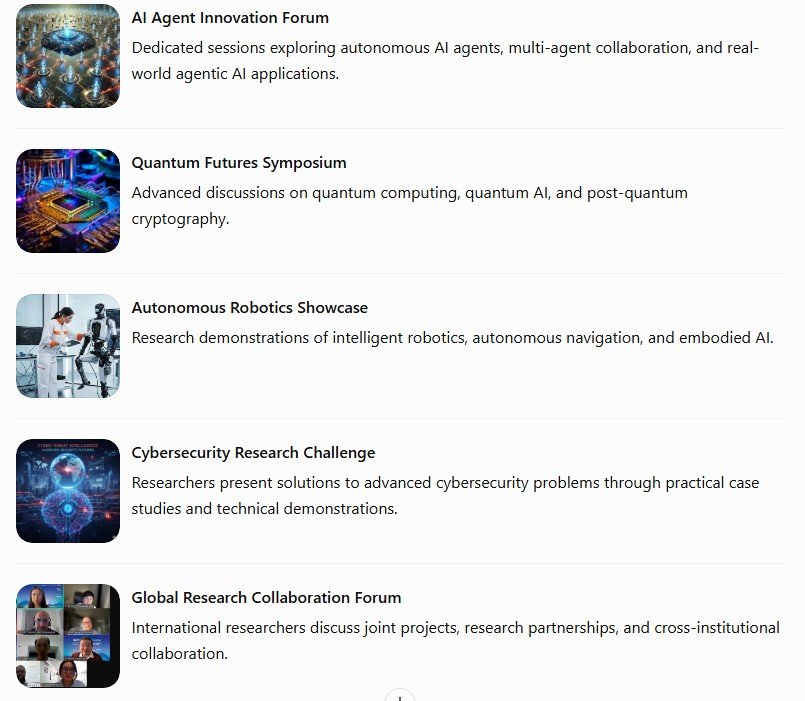
What will make ICATA 3 different?
Research submission categories
CATA 3 accept several types of scholarly contributions:
Full-length original research papers.
Review and systematic literature review papers.
Experimental and applied research.
AI and engineering prototypes.
Technical case studies.
Interdisciplinary research contributions.
Emerging technology and proof-of-concept studies.
Conference structure
Day | Main program |
Day 1 – March 21 | Opening ceremony, international keynote sessions, AI and foundation models, quantum technology |
Day 2 – March 22 | Technical research sessions, robotics demonstrations, cybersecurity forum, workshops |
Day 3 – March 23 | Industry innovation, research presentations, collaboration forum, awards and closing ceremony |
March 21–23, 2027
International Hybrid/Online Conference
March 21-23 2027
Conference chair

Geoffrey Hinton
Professor of Artificial Intelligence and Computational Sciences

Daphne Koller
Principal associateComputer Engineering and Emerging Technologies
Invited Speakers
Registration
Category Early Registration Regular Registration Late Registration Students $50 $70 $100 Academics / Researchers $100 $130 $150 Industry Professionals $150 $200 $250
Important Dates
Activity | Proposed date |
|---|---|
Conference announcement | December 10, 2026 |
Call for Papers | December 15, 2026 |
Abstract submission deadline | February 10, 2027 |
Full paper submission | February 25, 2027 |
Review completion | March 5, 2027 |
Acceptance notification | March 8, 2027 |
Camera-ready submission | March 14, 2027 |
Conference | March 21–23, 2027 |
Additional Considerations
- Early registration is typically 1 months before the event.
- Regular registration is until 2 weeks before the event.
- Late registration includes last-minute signups (often 1-2 weeks before the event).
Suggested publication policy:
Peer-reviewed conference proceedings, with selected high-quality papers invited for extended journal submissions. Do not advertise Scopus or other indexing until the specific publication arrangement is confirmed.
Virtual Conference Platform
ICATA 2027 will be hosted on a cutting-edge virtual platform, enabling attendees to join from anywhere in the world.
The platform will feature live streaming throug Google Meet of keynote speeches, technical sessions, workshops, and networking opportunities.
Sponsors and Partners
We are grateful for the support of our sponsors and partners InterviaUniversity who make this event possible. If you are interested in sponsoring ICATA 2027, please contact us at atikanishat1@gmail.com
Contact
All questions about submissions should be emailed to atika@interviauniversity.com